
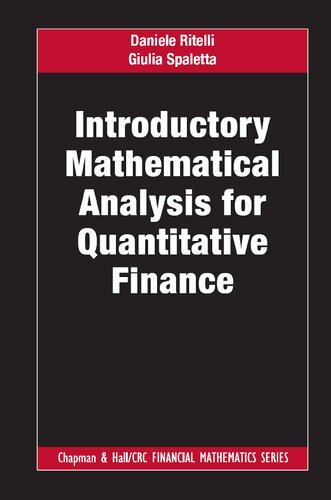
Introductory Mathematical Analysis for Quantitative Finance Chapman and Hall CRC Financial Mathematics Series 1st Edition by Daniele Ritelli, Giulia Spaletta 0815372547 9780815372547

Original price was: $50.00.$25.00Current price is: $25.00.
Introductory Mathematical Analysis for Quantitative Finance (Chapman and Hall/CRC Financial Mathematics Series) 1st Edition by Daniele Ritelli, Giulia Spaletta – Ebook PDF Instant Download/Delivery: 0815372547, 9780815372547
Full download Introductory Mathematical Analysis for Quantitative Finance (Chapman and Hall/CRC Financial Mathematics Series) 1st Edition after payment
Product details:
ISBN 10: 0815372547
ISBN 13: 9780815372547
Author: Daniele Ritelli, Giulia Spaletta
Introductory Mathematical Analysis for Quantitative Finance (Chapman and Hall/CRC Financial Mathematics Series) 1st Table of contents:
1 Euclidean space
1.1 Vectors
1.2 Topology of ℝn
1.3 Limits of functions
2 Sequences and series of functions
2.1 Sequences and series of real or complex numbers
2.2 Sequences of functions
2.3 Uniform convergence
2.4 Series of functions
2.5 Power series: radius of convergence
2.6 Taylor–Maclaurin series
2.6.1 Binomial series
2.6.2 The error function
2.6.3 Abel theorem and series summation
2.7 Basel problem
2.8 Extension of elementary functions to the complex field
2.8.1 Complex exponential
2.8.2 Complex goniometric hyperbolic functions
2.8.3 Complex logarithm
2.9 Exercises
2.9.1 Solved exercises
2.9.2 Unsolved exercises
3 Multidimensional differential calculus
3.1 Partial derivatives
3.2 Differentiability
3.3 Maxima and Minima
3.4 Sufficient conditions
3.5 Lagrange multipliers
3.6 Mean–Value theorem
3.7 Implicit function theorem
3.8 Proof of Theorem 3.22
3.9 Sufficient conditions
4 Ordinary differential equations of first order: general theory
4.1 Preliminary notions
4.1.1 Systems of ODEs: equations of high order
4.2 Existence of solutions: Peano theorem
4.3 Existence and uniqueness: Picard–Lindelöhf theorem
4.3.1 Interval of existence
4.3.2 Vector–valued differential equations
4.3.3 Solution continuation
5 Ordinary differential equations of first order: methods for explicit solutions
5.1 Separable equations
5.1.1 Exercises
5.2 Singular integrals
5.3 Homogeneous equations
5.3.1 Exercises
5.4 Quasi homogeneous equations
5.5 Exact equations
5.5.1 Exercises
5.6 Integrating factor for non–exact equations
5.6.1 Exercises
5.7 Linear equations of first order
5.7.1 Exercises
5.8 Bernoulli equation
5.8.1 Exercises
5.9 Riccati equation
5.9.1 Cross–Ratio property
5.9.2 Reduced form of the Riccati equation
5.9.3 Connection with the linear equation of second order
5.9.4 Exercises
5.10 Change of variable
5.10.1 Exercises
6 Linear differential equations of second order
6.1 Homogeneous equations
6.1.1 Operator notation
6.1.2 Wronskian determinant
6.1.3 Order reduction
6.1.4 Constant–coefficient equations
6.1.5 Cauchy–Euler equations
6.1.6 Invariant and normal form
6.2 Non–homogeneous equation
6.2.1 Variation of parameters
6.2.2 Non–homogeneous equations with constant coefficients
6.2.3 Exercises
7 Prologue to Measure theory
7.1 Set theory
7.1.1 Sets
7.1.2 Indexes and Cartesian product
7.1.3 Cartesian product
7.1.4 Functions
7.1.5 Equivalences
7.1.6 Real intervals
7.1.7 Cardinality
7.1.8 The Real Number System
7.1.9 The extended Real Number System
7.2 Topology
7.2.1 Closed sets
7.2.2 Limit
7.2.3 Closure
7.2.4 Compactness
7.2.5 Continuity
8 Lebesgue integral
8.1 Measure theory
8.1.1 σ–algebras
8.1.2 Borel sets
8.1.3 Measures
8.1.4 Exercises
8.2 Translation invariance
8.2.1 Exercises
8.3 Simple functions
8.3.1 Integral of simple functions
8.4 Measurable functions
8.5 Lebesgue integral
8.6 Almost everywhere
8.7 Connection with Riemann integral
8.7.1 The Riemann integral
8.7.2 Lebesgue–Vitali theorem
8.7.3 An interesting example
8.8 Non Lebesgue integrals
8.8.1 Dirac measure
8.8.2 Discrete measure
8.9 Generation of measures
8.10 Passage to the limit
8.10.1 Monotone convergence
8.10.1.1 Analytic functions
8.10.2 Exercises
8.10.3 Dominated convergence
8.10.4 Exercises
8.10.5 A property of increasing functions
8.11 Differentiation under the integral sign
8.11.1 The probability integral (1)
8.11.2 The probability integral (2)
8.11.3 Exercises
8.12 Basel problem again
8.13 Debye integral
9 Radon–Nikodym theorem
9.1 Signed measures
9.2 Radon–Nikodym theorem
10 Multiple integrals
10.1 Integration in ℝ2
10.1.1 Smart applications of Fubini theorem
10.1.1.1 Fresnel integrals
10.1.1.2 Cauchy formula for iterated integration
10.1.1.3 A challenging definite integral
10.1.1.4 Frullani integral
10.1.1.5 Basel problem, once more
10.2 Change of variable
10.3 Integration in ℝn
10.3.1 Exercises
10.4 Product of σ–algebras
11 Gamma and Beta functions
11.1 Gamma function
11.2 Beta function
11.2.1 Γ(12) and the probability integral
11.2.2 Legendre duplication formula
11.2.3 Euler reflexion formula
11.3 Definite integrals
11.4 Double integration techniques
12 Fourier transform on the real line
12.1 Fourier transform
12.1.1 Examples
12.2 Properties of the Fourier transform
12.2.1 Linearity
12.2.2 The Shift theorem
12.2.3 The Stretch theorem
12.2.4 Combining shifts and stretches
12.3 Convolution
12.4 Linear ordinary differential equations
12.5 Exercises
13 Parabolic equations
13.1 Partial differential equations
13.1.1 Classification of second–order linear partial differential equations
13.2 The heat equation
13.2.1 Uniqueness of solution: homogeneous case
13.2.2 Fundamental solutions: heat kernel
13.2.3 Initial data on (0, ∞)
13.3 Parabolic equations with constant coefficients
13.3.1 Exercises
13.4 Black–Scholes equation
13.4.1 Exercises
13.5 Non–homogeneous equation: Duhamel integral
People also search for Introductory Mathematical Analysis for Quantitative Finance (Chapman and Hall/CRC Financial Mathematics Series) 1st:
what is quantitative analysis in finance
what math is needed for quantitative finance
math used in quantitative finance
introduction to mathematical finance pdf
introduction to mathematical finance
Tags: Introductory, Mathematical, Analysis, Quantitative Finance, Hall CRC, Financial Mathematics, Daniele Ritelli, Giulia Spaletta
You may also like…
Mathematics


Science (General)
Computers - Computer Science
Mathematical Analysis and the Mathematics of Computation 1st Edition Werner Römisch
Business & Economics - Econometrics
Education Studies & Teaching - School Education & Teaching
Introductory mathematical analysis. Fourteenth Edition Ernest F. Haeussler