

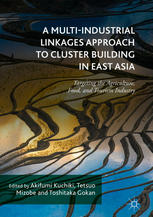
A Multi Industrial Linkages Approach to Cluster Building in East Asia Targeting the Agriculture, Food, and Tourism Industry 1st Edition by Akifumi Kuchiki, Tetsuo Mizobe, Toshitaka Gokan 1137571274 9781137571274

Original price was: $50.00.$25.00Current price is: $25.00.
A Multi-Industrial Linkages Approach to Cluster Building in East Asia: Targeting the Agriculture, Food, and Tourism Industry 1st Edition by Akifumi Kuchiki, Tetsuo Mizobe, Toshitaka Gokan – Ebook PDF Instant Download/Delivery: 1137571274, 9781137571274
Full download A Multi-Industrial Linkages Approach to Cluster Building in East Asia 1st Edition after payment
Product details:
ISBN 10: 1137571274
ISBN 13: 9781137571274
Authors: Akifumi Kuchiki, Tetsuo Mizobe, Toshitaka Gokan
This book proposes measures to promote regional industrial development in East Asia from the perspective of three industries: agriculture, food, and tourism. The authors argue that for regional agriculture to develop, collaboration with the food industry is essential. Further, by linking tourism, economic collaboration between the three industries is strengthened. The first part of the book introduces a basic model for the formation of the agriculture, food, and tourism industry cluster. Contributions from leading academics in agricultural economics then go on to discuss the relevance of this multi-industry cluster in countries such as Japan, the Republic of Korea, and Cambodia, amongst others. The final part sets out new approaches for further development in the cluster through quantitative analyses of the ‘economies of sequence’ concept. Readers will discover that from establishing linkages between different industries and other economic sectors, important positive externalities can be generated and these processes can be triggered on the local or cluster level.
A Multi-Industrial Linkages Approach to Cluster Building in East Asia 1st Table of contents:
Part I: Introduction
1. Basic Concept and Summary
1.1 The Basic Concept
1.1.1 The Concept of This Book
1.1.2 The Purposes of the Book
1.1.3 The Main Findings in the Book
1.1.4 The Application of Biological Development to Industrial Cluster Policy: Time Axis
1.1.5 The Definition of Economies of Sequence
1.1.6 Prototype Models of the Flowchart Approach to Industrial Cluster Policy
1.1.6.1 The Automobile Industry Cluster and the Electric/Electronics Industry Cluster
1.1.6.2 The Information Technology Industry Cluster
1.2 The Agriculture-Food-Tertiary Industry Cluster
1.2.1 Definition of the Agri-Food-Tourism Industry Cluster
1.2.2 Attention to Production Value by the Agro-Food System
1.2.3 Necessity for Vertical Integration of Agriculture, Food, Tourism
1.2.4 Attention to the East Asian Economic Bloc
1.3 Summary of This Book
1.4 Part II: Fact Finding — Experiences of Agriculture-Food-Tourism Industry Clusters
1.4.1 Chapter 2: AFT Industry Clusters in China
1.4.2 Chapter 3: AFT Cluster in the Republic of Korea
1.4.3 Chapter 4: AFT Cluster in Japan
1.4.4 Chapter 5: AFT Cluster in Okinawa
1.4.5 Chapter 6: Tourism Development in Cambodia
1.4.6 Chapter 7: Industry Collocation in Vietnam
1.5 Part III: New Approaches to Cluster Analysis
1.5.1 Chapter 8: Biological Levels of Organization Applied to Clusters
1.5.2 Chapter 9: Railway-Led AFT Cluster Formation
1.5.3 Chapter 10: Economies of Sequence — Airport Construction Impact
1.5.4 Chapter 11: Flowchart Approach to Agro-Food-Processing
1.5.5 Chapter 12: Comparing IT Clusters and Agro-Food Clusters
1.5.6 Chapter 13: Biological Applications to Segment Formation
Part II: Fact Findings — Agriculture, Food, and Tourism Industry Clusters
2. Agriculture-Food-Tourism Industry Clusters in China
2.1 Introduction
2.2 Policy Background
2.3 Current Situation
2.4 Role of Leading Firms
2.5 Roles of Local Government
2.6 Conclusion
References (English / Chinese / Japanese)
3. AFT Cluster in the Republic of Korea: Formation and Growth
3.1 Introduction
3.2 Regional Agriculture Clusters in Korea
3.2.1 Background
3.2.2 Program Details
3.2.3 Current Situation
3.2.4 Characteristics
3.3 Case Study: Formation & Growth
3.4 Overview of the Boseong Green Tea Cluster
3.4.1 Boseong County
3.4.2 Development Trigger
3.4.3 Roles of Agents
3.4.4 Economic Effects
3.4.5 Growth Factors
• Existence of Central Resources
• Local Government Promotion
• Networking Among Agents
3.5 Conclusion
References
4. AFT Cluster in Japan: Tourism Cluster Case Studies
4.1 Introduction
4.2 Tourism Development & Culture
4.2.1 Background
4.2.2 Cultural Components: Okinawa
4.2.3 Cultural Components: Japan & Central Vietnam
4.3 Overviews: Aichi, Nagoya, Expo, Airport
4.4 Future Issues
References
5. AFT Cluster in Okinawa: Airport as Key Driver
5.1 Introduction
5.1.1 Possible Sequences in Yaeyama
• Ripple Effect of New Ishigaki Airport
• Sequence After Opening & Impacts
5.1.2 Airport from Tourism Marketing Perspective
• Survey Method
• Respondent Characteristics
• Perceptions of Airport Opening
• Activities & Evaluation
• Spending & Revisit Intentions
5.2 Conclusion
References / URLs
6. Tourism Development in Cambodia
6.1 Introduction
6.2 Economic Growth & Industry Trends
6.3 Tourism Resources: Food Culture Routes
6.4 Khmer Food Culture: Fish Processing
6.5 Daily Meals
6.6 Creation of Local Specialties via AFT Clusters
6.7 Summary
References
7. Collocation of Industries in AFT in Vietnam
7.1 Introduction
7.2 Spatial Structures
7.3 Industry Collocation
7.4 Conclusion
Appendices A–B
References (Japanese)
Part III: New Approaches for Cluster Analysis
8. Applying Biological Levels to Industrial Cluster Processes
8.1 Introduction
8.2 Biological Hierarchy & Economies of Sequence
8.3 Sequence of Segment Formation
8.4 Examples in East Asia
8.4.1 Thailand’s ESDP
8.4.2 Electronics Cluster in North Vietnam
8.5 Relation to Flowchart Approach
8.6 Summary
Appendices A–B
9. Railway-Led Formation of AFT Clusters
9.1 Introduction
9.2 Railway-Based New Economic Geography
9.2.1 Without Railways
9.2.2 With Railways
9.3 Upgrading Consumption Quality
9.4 AFT Cluster Formation for Upgrading
9.5 Prototype Railway Models
9.6 Conclusion
References (Japanese / English)
10. Quantitative Analyses of Economies of Sequence
10.1 Introduction
10.2 Tourism Cluster Formation & Airports
10.3 Tourism Growth & Economic Impact
10.4 Granger Causality Testing
10.5 Summary
References
11. Flowchart Approach to Agro-Food-Processing Clusters in East Asia
11.1 Introduction
11.2 Prototype Model for Manufacturing Clusters
11.3 Linkages in East Asia vs USA
11.4 Agriculture & Food Industry Cluster Effects
11.5 Case Study: Africa (Nacala Corridor)
11.6 Conclusion
References
12. Comparing IT Industry Clusters with Agro-Food Clusters
12.1 Introduction
12.2 Flowchart Approach
12.3 IT Cluster in Beijing
12.4 Innovation
12.5 Conclusions
References
People also search for A Multi-Industrial Linkages Approach to Cluster Building in East Asia 1st:
east asia industrial clusters
agriculture and tourism integration
regional development strategies
economic linkages model
cluster-based economic growth
Tags: A Multi Industrial, Approach, Cluster Building, Targeting, Agriculture, Food, Tourism Industry, Akifumi Kuchiki, Tetsuo Mizobe, Toshitaka Gokan
You may also like…
Politics & Philosophy
Food Security and Industrial Clustering in Northeast Asia 1st Edition Lily Kiminami

Cookbooks

Jurisprudence & Law - Criminology: Court. Examination
Food Crime : an introduction to deviance in the food industry Robinson

Business & Economics - Industries
Marketing in Food Hospitality Tourism and Food 2nd Edition Richard Tresidde
Business & Economics
Business & Economics

Business & Economics - Industries

Earth Sciences - The Environment