

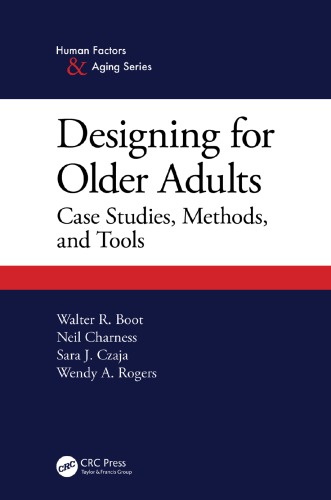
Designing for older adults Case studies methods and tools 1st edition by Walter Boot, Neil Charness, Sara Czaja, Wendy Rogers ISBN 113805285X 978-1138052857


Original price was: $50.00.$25.00Current price is: $25.00.
Designing for older adults Case studies, methods, and tools 1st edition by Walter Boot, Neil Charness, Sara Czaja, Wendy Rogers – Ebook PDF Instant Download/Delivery: 113805285X , 978-1138052857
Full download Designing for older adults Case studies, methods, and tools 1st edition after payment
Product details:
ISBN 10: 113805285X
ISBN 13: 978-1138052857
Author: Walter Boot, Neil Charness, Sara Czaja, Wendy Rogers
Designing for Older Adults: Case Studies, Methods, and Tools
There are many products, tools, and technologies available that could provide support for older adults. However, their success requires that they are designed with older adults in mind by being aware of, and adhering to, design principles that recognize the needs, abilities, and preferences of diverse groups of older adults. Achieving good design is a process facilitated by seeing principles and guidelines in action. Design success requires understanding how to use the methods and tools available to evaluate initial ideas and prototypes. The goal of this book is to provide illustrative “case studies” of designing for older adults based on real design challenges faced by the researchers of the Center for Research and Education on Aging and Technology Enhancement (CREATE) over the past two decades. These case studies exemplify the use of human factors tools and user-centered design principles to understand the needs of older adults, identify where existing designs failed older users, and examine the effectiveness of design changes to better accommodate the abilities and preferences of the large and growing aging population.
Designing for older adults Case studies, methods, and tools 1st Table of contents:
Chapter 1 Introduction
1.1 Conceptual Framework
1.2 The Importance of Designing for Older Adults
1.3 Understanding the Older User
1.3.1 Perceptual and Cognitive Abilities
1.3.2 Anthropometry, Movement Control, and Strength
1.3.3 Technology Experience and Attitudes
1.3.4 The Importance of Considering Variability
1.4 Preview of Case Study Examples
1.5 Conclusions
References
Additional Recommended Readings
Chapter 2 Defining Older Adult User Groups
2.1 Older Adult User Groups
2.2 Diversity of the Older Adult Population
2.3 Considering Diversity of the Older Adult Population in Design
2.4 Case Study 1: Electronic Health Records (EHRs)
2.4.1 Research Questions
2.4.2 Examining How Individual Characteristics Influence Use of a Patient Portal
2.4.3 Design Value
2.5 Case Study 2: A Technology-Based Caregiver Intervention Program
2.5.1 Research Questions
2.5.2 Designing the VideoCare System to Accommodate Individual Differences
2.5.3 Design Value
2.6 Conclusions
References
Additional Recommended Readings
Chapter 3 Assessing Needs with Older Adults
3.1 Needs Assessment for Design
3.2 Needs Assessment Techniques
3.3 Case Study 1: Healthcare Applications
3.3.1 Research Questions
3.3.2 Illustration of Comparative App Analysis
3.3.3 Design Value
3.4 Case Study 2: Digital Home Assistants
3.4.1 Research Questions
3.4.2 Identifying Preferences for Digital Home Assistants
3.4.3 Design Value
3.5 Case Study 3: Design of a Personal Robot for the Home
3.5.1 Research Questions
3.5.2 Understanding Older Adults’ Needs and Preferences for Robots
3.5.3 Design Value
3.6 Conclusions
References
Additional Recommended Readings
Chapter 4 Implementing Usability Methods
4.1 Usability Methods
4.1.1 Cognitive Walkthrough
4.1.2 Heuristic Evaluation
4.1.3 Task Analyses
4.1.4 User Testing: Formative and Summative Evaluation
4.2 Case Study 1: Understanding Technology Use Challenges
4.2.1 Research Questions
4.2.2 Illustration of Group Interview Approach
4.2.3 Design Value
4.3 Case Study 2: As Easy as 1, 2, 3?
4.3.1 Research Questions
4.3.2 Task Analytic Approach
4.3.3 Design Value
4.4 Case Study 3: Designing Better Ballots
4.4.1 Research Questions
4.4.2 Testing Users Experimentally
4.4.3 Design Value
4.5 Case Study 4: Usability of Fitness Applications (Apps)
4.5.1 Research Questions
4.5.2 Insights from Multiple Usability Methods Guide Design and Deployment
4.5.3 Design Value
4.6 Conclusions
References
Additional Recommended Readings
Chapter 5 Simulation for Design
5.1 Simulation Value for Design
5.1.1 Simulation Overview
5.1.2 Simulation Use in Design
5.1.3 Domains of Application
5.2 Simulation Implementation
5.2.1 Capturing the Behavior of Interest
5.2.2 Challenges of Using Simulation
5.2.3 Simulator and Cyber Sickness
5.2.4 Training and Adaptation
5.2.5 Other Technical Challenges
5.3 Case Study 1: Wrong-Way Crashes
5.3.1 Research Questions
5.3.2 Simulation Design
5.3.3 Simulation Implementation
5.3.4 Design Value
5.4 Case Study 2: Instrumental Activities of Daily Living Simulation
5.4.1 Research Questions
5.4.2 Simulation Design
5.4.3 Simulation Implementation
5.4.4 Design Value
5.5 Conclusions
References
Additional Recommended Readings
Chapter 6 Modeling Older Adult Performance
6.1 History of Modeling
6.2 Tools That Can Be Used in the Modeling Process: Fitts’ Law and GOMS Modeling
6.3 Case Study 1: Using Fitts’ Law to Predict Touchscreen Input
6.3.1 Research Questions
6.3.2 How Diversity Influences Performance
6.3.3 Design Value for Modeling
6.4 Case Study 2: Using GOMS to Predict Time and Error for a Mobile Device
6.4.1 Research Questions
6.4.2 How Diversity Influences Performance
6.4.3 Design Value
6.5 Case Study 3: Using GOMS to Predict Time for Driver Decision Making
6.5.1 Research Questions
6.5.2 How Diversity Influences Performance
6.5.3 Design Value
6.6 Conclusions
References
Additional Recommended Readings
Chapter 7 Designing Instructional Support
7.1 Introduction
7.1.1 Support as an Underutilized Part of the Design Process
7.1.2 Older Adults Do Read Manuals
7.1.3 Iterative Design for Instructional Materials
7.2 Case Study 1: Design of Instructional Support for Telephone Menu Systems
7.2.1 Research Questions
7.2.2 How Diversity Influences Performance
7.2.3 Design Value
7.3 Case Study 2: Blood Glucose Meter Usability
7.3.1 Research Questions
7.3.2 Design Value
7.4 Case Study 3: Florida DOT Tip Card Project
7.4.1 Research Questions
7.4.2 Design Value
7.5 Conclusions
References
Additional Recommended Readings
Chapter 8 The Personal Reminder Information and Social Management System (PRISM)
8.1 The Issue: Social Isolation, Loneliness, and Older Adults
8.2 Description of the PRISM System
8.3 Design of the PRISM System: Understanding
8.3.1 Defining the Design Problem
8.3.2 Empathize: Understanding Our Intended User Group
8.4 Design of the PRISM System: Exploration
8.4.1 Ideate
8.4.1.1 Design of the PRISM Software
8.4.1.2 Design of the Instructional Materials
8.4.2 Prototype Development
8.5 Design of the PRISM System: Materializing
8.5.1 Usability Analysis
8.5.2 Pilot Testing of the PRISM Prototype
8.5.3 Implementation: A Randomized Controlled Trial of the PRISM System
8.5.3.1 Overview of the Field Trial
8.5.3.2 Main Findings
8.6 Design Value
8.7 Conclusions
References
Additional Recommended Readings
Chapter 9 Emerging Challenges and Approaches
9.1 Will Design for Older Adults Continue to Be Relevant?
9.2 Technology Trends and Emerging Technologies
9.2.1 Technology Advances
9.2.2 Anticipating Future Design Challenges
9.2.3 Defining a Research Agenda
9.3 Emerging Approaches
9.4 Conclusions
References
People also search for Designing for older adults Case studies, methods, and tools 1st :
how to design a case control study
designing for older adults pdf
older adult case studies
designing for older adults
designing for adults
Tags: Walter Boot, Neil Charness, Sara Czaja, Wendy Rogers, older adults, Case studies
You may also like…
Politics & Philosophy
Medicine - Medicine & Nursing Reference
Home-Based Medical Care for Older Adults: A Clinical Case Book 1st Edition Jessica L. Colburn

Cookbooks

Relationships & Lifestyle - Aging
Primary Care for Older Adults: Models and Challenges 1st Edition Michael Wasserman

Medicine - Nursing
Engineering