

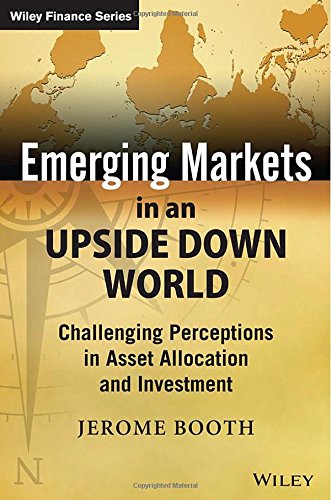
Emerging Markets in an Upside Down World Challenging Perceptions in Asset Allocation and Investment 1st Edition by Jerome Booth ISBN 1118879678 978-1118879672


Original price was: $50.00.$25.00Current price is: $25.00.
Emerging Markets in an Upside Down World Challenging Perceptions in Asset Allocation and Investment 1st Edition by Jerome Booth – Ebook PDF Instant Download/Delivery: 1118879678, 978-1118879672
Full download Emerging Markets in an Upside Down World Challenging Perceptions in Asset Allocation and Investment 1st edition after payment
Product details:
ISBN 10: 1118879678
ISBN 13: 978-1118879672
Author: Jerome Booth
The world is upside down. The emerging market countries are more important than many investors realise. They have been catching up with the West over the past few decades. Greater market freedom has spread since the end of the Cold War, and with it institutional changes which have further assisted emerging economies in becoming more productive, flexible, and resilient. The Western financial crisis from 2008 has quickened the pace of the relative rise of emerging markets – their relative economic power, and with it political power, but also their financial power as savers, investors and creditors.
Emerging Markets in an Upside Down World – Challenging Perceptions in Asset Allocation and Investment argues that finance theory has misunderstood risk and that this has led to poor investment decisions; and that emerging markets constitute a good example of why traditional finance theory is faulty. The book accurately describes the complex and changing global environment currently facing the investor and asset allocator. It raises many questions often bypassed because of the use of simplifying assumptions and models. The narrative builds towards a checklist of issues and questions for the asset allocator and investor and then to a discussion of a variety of regulatory and policy issues.
Aimed at institutional and retail investors as well as economics, finance, business and international relations students, Emerging Markets in an Upside Down World covers many complex ideas, but is written to be accessible to the non-expert.
Emerging Markets in an Upside Down World Challenging Perceptions in Asset Allocation and Investment 1st Table of contents:
I.1 Upside down: perception vs reality
I.2 The structure of the book
1 Globalisation and the Current Global Economy
1.1 What is globalisation?
1.2 Economic history and globalisation
1.2.1 The desire to control and its impact on trade
1.2.2 The influence of money
1.2.3 Trade and commodification
1.2.4 Nationalism
1.3 Recent globalisation
1.3.1 Bretton Woods
1.3.2 Ideological shifts
1.3.3 Participating in globalisation: living with volatility
2 Defining Emerging Markets
2.1 The great global rebalancing
2.1.1 Financing sovereigns
2.1.2 Catching up
2.1.3 The poorest can also emerge: aid and debt
2.1.4 From debt to transparency and legitimacy
2.2 Investing in emerging markets
2.3 Emerging market debt in the 20th century
2.3.1 Types of external sovereign debt
2.3.2 From Mexican crisis to Brady bonds
2.3.3 Market discipline
2.3.4 Eastern Europe
2.3.5 Mexico in crisis again
2.3.6 The Asian and Russian crises
2.3.7 Emerging markets grow up
(a) The first change: country and contagion risks fall
(b) The second change: the investor base
2.3.8 Testing robustness: Argentina defaults
2.3.9 The end of the self-fulfilling prophecy
2.4 The growth of local currency debt
2.5 Why invest in emerging markets?
3 The 2008 Credit Crunch and Aftermath
3.1 Bank regulation failure
3.1.1 Sub-prime
3.2 The 2008 crisis
3.3 Depression risk
3.3.1 Reducing the debt
3.3.2 Deleveraging is not an emerging market problem
3.4 Global central bank imbalances
4 Limitations of Economics and Finance Theory
4.1 Theoretical thought and limitations
4.2 Economics, a vehicle for the ruling ideology
4.3 Macroeconomics
4.4 Microeconomic foundations of macroeconomics
4.4.1 Efficient market hypothesis
4.4.2 Modern portfolio theory
4.4.3 Investment under uncertainty
4.5 Bounded decisions and behavioural finance
5 What is Risk?
5.1 Specific and systematic risk
5.2 Looking backwards
5.3 Uncertainty
5.4 Risk and volatility
5.5 Risk in emerging markets
5.6 Rating agencies
5.7 Capacity, willingness, trust
5.7.1 Rich countries default by other means
5.7.2 Two sets of risk in emerging markets
5.8 Sovereign risk: a three-layer approach
5.9 Prejudice, risk and markets
5.9.1 When you have a hammer, everything looks like a nail
6 Core/Periphery Disease
6.1 The core/periphery paradigm
6.1.1 Core breach?
6.1.2 Another core/periphery concept: decoupling
6.1.3 And another: spreads
6.2 Beyond core/periphery
6.2.1 Towards a relative theory of risk
6.2.2 GDP weighting
7 The Structure of Investment
7.1 Misaligned incentives
7.2 Confused incentives
7.3 Evolutionary dynamics, institutional forms
7.3.1 History matters
7.4 Network theory
7.5 Game theory
7.6 Investor structure and liquidity
7.7 Market segmentation
7.7.1 Warning signals
7.8 Investor base structure matters
8 Asset Allocation
8.1 Asset classes
8.1.1 Alternatives
8.2 How asset allocation occurs today
8.2.1 Investor types
8.2.2 Asset/liability management
8.3 From efficiency frontiers to revealed preferences
8.4 Asset allocation vs manager selection; active vs passive
8.5 Allocating at sea
9 Thinking Strategically in the Investment Process
9.1 Thinking strategically
9.1.1 Thinking strategically: appropriate discounting
9.2 Scenario planning
9.3 Global structural shifts ahead?
9.3.1 Asset allocation: some proposed new rules
9.4 Investment process in emerging debt
9.5 Conclusion
10 A New Way to Invest
10.1 Sense-checking assumptions
10.1.1 Risk, uncertainty and information asymmetry assumptions
10.1.2 Investor psychology and behaviour assumptions
10.1.3 Structure, market efficiency, equilibrium and market dynamics
10.1.4 Asset class definitions
10.2 Assessing liabilities
10.3 Your constraints
10.3.1 The decision chain
10.3.2 Institutional capabilities
10.3.3 Psychological constraints
10.4 Consider changing your constraints: agency issues
10.5 Building scenarios
10.6 Understanding market structure
10.7 Asset allocation
10.7.1 Route 1: Comprehensive
10.7.2 Route 2: Entrepreneurial
10.7.3 Asset allocation dynamics
10.8 Meta-allocation: toolset choice
10.9 Follow the skillset
10.10 Portfolio construction and monitoring
11 Regulation and Policy Lessons
11.1 Regulating financial institutions: new and old lessons
11.1.1 Fix the banks
11.1.2 Non-banks: who holds what?
11.1.3 Reduce agency problems: trustee incentives
11.1.4 Honour public service
11.1.5 Choice architecture
11.2 What to do about systemic risk?
11.2.1 Avoid regulation that amplifies risk
11.2.2 Beware market segmentation
11.2.3 Structure matters
11.2.4 Map perceptions of risk
11.2.5 Detect and stop asset bubbles
11.2.6 Preserve credibility
11.3 Wish list for emerging market policymakers
11.3.1 Allow markets to work
11.3.2 Proclaim and foster greater pricing power
11.3.3 Promote EM global banks, south-south linkages
11.3.4 Build capital markets
11.3.5 Fight core/periphery disease
11.4 Reserve management and the international monetary system
11.4.1 The dollar is your problem
11.4.2 Alternatives to the dollar
11.4.3 Too many reserves
11.5 What investors can expect from HIDC policymakers
11.5.1 Financial repression
11.5.2 Consequences of financial repression for banks
11.5.3 No early exit from quantitative easing?
11.5.4 Bond crash
11.5.5 Inflation
11.5.6 Appeals to foreign investors
11.5.7 Regulatory muddle-through
11.5.8 Pension reform
11.5.9 Pension regulatory conflict may only abate once EM investors exit
11.5.10 Rating agencies
11.5.11 Intellectual reassessment
11.6 What investors can expect from emerging market policymakers
12 Conclusion
12.1 A final list…
12.2 … for an upside down world
People also search for Emerging Markets in an Upside Down World Challenging Perceptions in Asset Allocation and Investment 1st :
emerging markets in an upside down world
emerging markets explained
emerging markets jobs
emerging markets and inflation
emerging markets inverse etf
emerging markets undervalued
You may also like…

Business & Economics
Underwater Options When Your Mortgage Is Upside Down 1st Edition Chris Lauer (Auth.)

Business & Economics
Strategic Marketing Cases in Emerging Markets 1st Edition Atanu Adhikari


Uncategorized
Investing in Emerging and Frontier Markets 1st edition by Kamar Jaffer 1781371024 9781781371022

Business & Economics
Business & Economics - Investing
Business & Economics - Mathematical Economics

Business & Economics
Financial Decisions and Markets A Course in Asset Pricing John Y Campbell

Business & Economics