
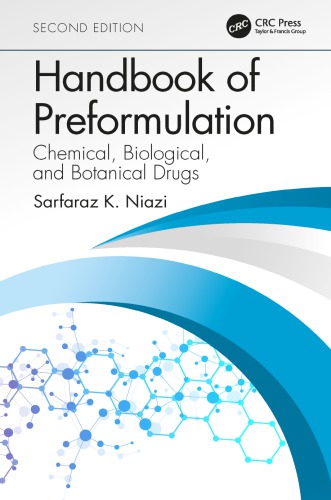
Handbook of Preformulation Chemical Biological and Botanical Drugs 2nd edition by Sarfaraz K Niazi 1138297550 9781138297555

Original price was: $50.00.$25.00Current price is: $25.00.
Handbook of Preformulation Chemical Biological and Botanical Drugs 2nd Edition by Sarfaraz K. Niazi – Ebook PDF Instant Download/Delivery: 1138297550, 9781138297555
Full download Handbook of Preformulation Chemical Biological and Botanical Drugs 2nd Edition after payment
Product details:
ISBN 10: 1138297550
ISBN 13: 9781138297555
Author: Sarfaraz K. Niazi
Preformulation studies are the physical, chemical, and biological studies needed to characterize a drug substance for enabling the proper design of a drug product, whereas the effectiveness of a drug product is determined during the formulation studies phase. Though the two disciplines overlap in practice, each is a significantly distinct phase of new drug development. Entirely focused on preformulation principles, this fully revised and updated Handbook of Preformulation: Chemical, Biological, and Botanical Drugs, Second Edition provides detailed descriptions of preformulation methodologies, gives a state-of-the-art description of each technique, and lists the currently available tools useful in providing a comprehensive characterization of a new drug entity. Features: Addresses the preformulation studies of three different types of new active entities – chemical, biological, and botanical, which is the latest established class of active ingredient classified by the FDA Illustrates the activities comprised in preformulation studies and establishes a method of tasking for drug development projects Includes extensive flow charts for characterization decision making Gives extensive theoretical treatment of principles important for testing dissolution, solubility, stability, and solid state characterization Includes over 50% new material
Handbook of Preformulation Chemical Biological and Botanical Drugs Table of contents:
1. Drug Discovery Trends
1.1 Introduction
1.1.1 Genome Editing
1.1.2 Microbiome
1.1.3 Antibiotics
1.1.4 Artificial Intelligence
1.1.5 Marijuana
1.1.6 Target-Based Discovery
1.1.7 High-Through Screening
1.1.8 Rational Drug Design
1.1.9 Target Family Knowledge
1.1.10 DNA-Encoded Library Technology
1.1.11 Phenotype
1.1.12 Biologics
1.1.13 Botanicals
1.2 The Preformulation Focus
1.3 Development Phases
1.3.1 Stage 1: Lead Finding or Establishing Directions (1–2 Years)
1.3.2 Stage 2: Candidate Drug Screening (1–10 Years)
1.3.3 Stage 3: Candidate Drug Selection (1–2 Years)
1.3.4 Stage 4: Preclinical Studies (1–2 Years)
1.3.5 Stage 5: Phase I Clinical Studies (1–2 Years)
1.3.6 Stage 6: Phase II and Phase III Studies and Launch (4–6 Years)
1.3.7 Stage 7: Postmarket Surveillance (3–5 Years)
1.4 Phytomedicines
1.5 Recombinant Drugs
Web References
Bibliography
2. Intellectual Property Considerations
2.1 Introduction
2.2 Patenting Strategies
2.2.1 Patenting Systems
2.2.2 What Is a Patent?
2.2.3 Patent Myths
2.2.4 What Is Not Patentable?
2.3 Patent Search
2.3.1 Internet Search Engines
2.3.2 Information Portals
2.3.3 Technical Databases
2.3.4 Patent Search and Intellectual Property Services
2.3.5 Patent Copies and Search Facilities
2.4 Components of a Patent Application
2.4.1 Drawing(s) (§113)
2.4.2 Specification (§112 ¶1)
2.4.3 Paragraph 1 35 USC §112 Requirements
2.4.4 Paragraph 2 35 USC §112 Requirement: Parts of a Claim
2.5 Understanding Claims
2.5.1 Reading a Claim
2.5.2 Punctuation of Claim
2.5.3 Definiteness of Claim
2.5.4 Narrowing of Claim
2.5.5 Dependent Claims (§112 ¶3 ¶4)
2.5.6 Multiple Dependent Claims (§112 ¶5)
2.5.7 Dominant-Subservient Claims
2.5.8 Means-Plus-Function Clauses §112 ¶6
2.5.9 Process Claims
2.5.10 Step-Plus-Function Clauses
2.5.11 Ranges
2.5.12 Negative Limitations
2.5.13 Relative and Exemplary Terminology
2.5.14 Markush Group
2.5.15 Markush Alternates
2.5.16 Jepson-Type Claims—Improvement Claims
2.5.17 Mixed-Class Claims
2.5.18 Product-by-Process Claims
2.5.19 Patent Term Adjustment
2.5.20 Patent and Trademark Office Delays: Guaranteed Adjustment Basis
2.5.21 Required Reduction Basis
2.6 Food and Drug Administration
Web References
Bibliography
Recommended Reading
3. The Scope of Preformulation Studies
3.1 Introduction
3.2 Preformulation Testing Criteria
3.3 Regulatory Requirements
3.3.1 Small Molecules/General
3.3.2 Phytomedicines
3.3.3 Large-Molecule Drugs
3.3.4 Recombinant DNA Products
3.4 Testing Systems
3.4.1 Polymorph Screening
3.4.2 pKa, Partitioning, and Solubility
3.4.3 Salt Screening
3.5 Solid-State Characterization
3.5.1 Powder Properties
3.5.2 Microscopy
3.5.3 Thermal Analysis
3.5.4 Molecular Spectroscopy
3.5.5 X-Ray Diffraction
3.5.6 Stability Testing
3.5.6.1 Moisture Isotherm
3.5.6.2 Excipient Compatibility
3.6 Transport Across Biological Membranes
3.6.1 Drug Efflux and Multidrug-Resistance Studies
3.6.2 In Vitro–In Vivo Correlation
3.6.3 Caco-2 Cell Studies
Web References
Bibliography
Recommended Reading
4. Dissociation, Partitioning, and Solubility
4.1 Introduction
4.2 The Ionization Principle
4.2.1 The Acid–Base Theory
4.2.1.1 Bronsted–Lowry Theory
4.2.1.2 Lewis Theory
4.2.1.3 Henderson–Hasselbalch Equation
4.2.1.4 The pH Scale
4.2.1.5 Compendia Specification for pH Measurement
4.2.1.6 Dissociation
4.3 Quantitative Structure–Activity Relationships
4.3.1 Hansch Analysis
4.4 Partitioning
4.4.1 Distribution Coefficient
4.4.2 Partitioning Solvent
4.4.3 Solubility
4.4.3.1 Molecular Size
4.4.3.2 Additives
4.4.3.3 Temperature
4.5 Measurement Strategies
4.5.1 Ion Pair Log P
4.5.1.1 Manual Titration
4.5.1.2 Spectroscopy
4.5.2 Solubility Method
4.5.3 Filter Probe Method
4.5.4 Shake-Flask Method
4.5.5 High-Pressure Liquid Chromatography
4.5.6 Capillary Zone Electrophoresis
4.5.7 Plate Method for Solubility Testing
Web References
Bibliography
Recommended Reading
5. Release, Dissolution, and Permeation
5.1 Introduction
5.2 Release
5.2.1 Solubility Modulation
5.3 Assay Systems
5.3.1 Permeability Assays
5.3.2 Parallel Artificial Membrane Permeability Analysis
5.3.3 Caco-2 Drug Transport Assays
5.3.4 Animal Model Testing
5.3.5 In Vitro–In Vivo Correlation
5.3.5.1 Internal Validation
5.4 Waiver of In Vivo Bioavailability and Bioequivalence Studies for Immediate-Release Solid Oral Dosage Forms Based on a Biopharmaceutics Classification System: Guidance for Industry
5.5 Using BDCS in Preformulation
Recommended Reading
6. Solid-State Properties
6.1 Introduction
6.2 Crystal Morphology
6.3 Polymorphism
6.4 High-Throughput Crystal Screening
6.4.1 Crystalline Index of Refraction
6.5 Solvates
6.5.1 Hydrates
6.6 Amorphous Forms
6.7 Hygroscopicity
6.8 Solubility
6.8.1 Salt Form
6.8.2 Melting Point
6.8.3 Dissolution
6.9 Study Methods
6.9.1 Thermal Analysis
6.9.2 Differential Scanning Calorimetry
6.9.3 Hot-Stage Microscopy
6.9.4 Thermogravimetric Analysis
6.9.5 Solution Calorimetry
6.9.6 Isothermal Microcalorimetry
6.9.7 Infrared Spectroscopy
6.9.8 X-Ray Powder Diffraction
6.9.9 Phase Solubility Analysis
6.9.10 Dynamic Vapor Sorption
6.9.11 Dissolution Testing
6.9.12 High-Performance Liquid Chromatography
Web References
Recommended Reading
7. Dosage Form Considerations in Preformulation
7.1 Introduction
7.2 Solid Dosage Form Considerations
7.2.1 Particle Size Studies
7.2.2 Particle Size Distribution
7.2.3 Surface Area
7.2.4 Porosity
7.2.5 Instrumentation for Particle Size, Surface Area, and Porosity
7.2.6 True Density
7.2.7 Flow and Compaction of Powders
7.2.8 Color
7.2.9 Electrostaticity
7.2.10 Caking
7.2.11 Polymorphism
7.3 Solution Formulations
7.3.1 Solubility
7.4 Emulsion Formulations
7.4.1 Stability Considerations
7.4.2 Oxidation
7.4.3 Trace Metals
7.4.4 Photostability
7.4.5 Surface Activity
7.4.6 Osmolality
7.5 Freeze-Dried Formulations
7.6 Suspensions
7.7 Topical
7.8 Pulmonary Delivery
7.9 General Compatibility
Web References
Recommended Reading
8. Chemical Drug Substance Characterization
8.1 Introduction
8.2 Scheme of Characterization
8.2.1 Specifications
8.2.1.1 Description
8.2.1.2 Identification
8.2.1.3 Chirality
8.2.2 Assay
8.2.2.1 Impurities
8.2.3 Physicochemical Properties
8.2.3.1 Particle Size
8.2.3.2 Polymorphic Forms
8.2.3.3 Microbiology
8.2.3.4 Excipients
8.2.4 Stability Evaluation
8.2.4.1 Hydrolysis
8.2.4.2 Oxidation
8.2.5 Regulatory Consideration in Stability Testing
8.2.5.1 Stress Testing
8.2.5.2 Selection of Batches
8.2.5.3 Container Closure System
8.2.5.4 Specifications
8.2.5.5 Testing Frequency
8.2.5.6 Stability Commitment
8.2.5.7 Statements/Labeling
8.3 Impurities
8.3.1 Good Manufacturing Practice
8.3.2 Quality Management
Web References
Recommended Reading
9. Characterization of Biopharmaceuticals
9.1 Background
9.1.1 Developing Biosimilars
9.2 Protein Structure
9.2.1 Building Elements
9.2.2 Translation
9.2.3 Peptide Bond
9.3 Motifs and Domains
9.4 Association and Aggregation
9.5 Posttranslational Modification
9.5.1 Glycosylation
9.6 Protein Expression Variability
9.7 Preformulation Considerations
9.8 Preformulation Studies
9.8.1 Stability
9.8.1.1 Excipients
9.9 Packaging and Materials
9.9.1 Dosage Form and Storage
9.9.2 Cryopreservation
9.9.2.1 Cryogranulation
9.9.2.2 Spray Drying
9.9.2.3 Undercooling
9.9.2.4 Lyophilization
9.9.3 Characterization Methods
9.9.3.1 Spectroscopy
9.9.3.2 Electrophoresis
9.9.3.3 Chromatography
9.9.3.4 Mass Spectroscopy
9.9.3.5 Process Validation
9.9.3.6 Facility and Equipment Validation
9.9.3.7 Analytical Methods
9.9.3.8 Software Validation
9.9.3.9 Cleaning Validation
9.9.3.10 Expression System Characterization
9.9.4 Stability Considerations
9.9.4.1 Proteolysis
9.9.4.2 Deamidation
9.9.4.3 Oxidation
9.9.4.4 Carbamylation
9.9.4.5 β-Elimination
9.9.4.6 Racemization
9.9.4.7 Cysteinyl Residues
9.9.4.8 Hydrolysis
9.9.4.9 Denaturation
9.9.4.10 Aggregation
9.9.4.11 Precipitation
9.9.5 Forced Degradation Studies
9.9.5.1 Stress Testing
9.9.5.2 Selection of Stress Conditions
9.9.6 Specifications
9.9.6.1 Physicochemical Properties
9.9.7 Biological Activity
9.9.8 Immunochemical Properties
9.9.9 Purity, Impurities, and Contaminants
9.9.9.1 Purity
9.9.9.2 Impurities
9.9.9.3 Contaminants
9.9.10 Quantity
9.9.11 Analytical Considerations
9.9.11.1 Reference Standards and Reference Materials
9.9.11.2 Validation of Analytical Procedures
9.9.12 Process Controls
9.9.13 Release Limits versus Shelf-Life Limits
9.9.14 Justification of Specifications
9.10 Physiochemical Characterization Tests
9.10.1 Structural Characterization and Confirmation
9.10.1.1 Amino Acid Sequence
9.10.1.2 Amino Acid Composition
9.10.1.3 Terminal Amino Acid Sequence
9.10.1.4 Peptide Map
9.10.2 Sulfhydryl Group(s) and Disulfide Bridges
9.10.3 Carbohydrate Structure
9.10.4 Physicochemical Properties
9.10.4.1 Molecular Weight or Size
9.10.4.2 Isoform Pattern
9.10.4.3 Extinction Coefficient (or Molar Absorptivity)
9.10.4.4 Electrophoretic Patterns
9.10.4.5 Liquid Chromatographic Patterns
9.11 Spectroscopic Profiles
9.11.1 Process-Related Impurities and Contaminants
9.11.2 Product-Related Impurities, Including Degradation Products
9.11.2.1 Truncated Forms
9.11.2.2 Other Modified Forms
9.11.2.3 Aggregates
9.12 Design of Preformulation Studies
Web References
Bibliography
Recommended Reading
10. Botanical Drugs
10.1 Introduction
10.2 Regulatory Status
10.2.1 Characteristics of Phytomedicines
10.2.2 Specifications
10.2.2.1 Standardization
10.2.3 Efficacy and Safety
10.2.4 Regulatory Filing Procedure
10.2.4.1 Plant Substance
10.2.4.2 Product (Capsule, Tablet, and Intravenous Formulation)
10.2.5 Overview of Chemistry, Manufacturing, and Control Evidence Needed to Support Clinical Trials for Botanical Drugs
10.2.6 Information on a Plant Product That Was the Subject of Prior Human Use
10.2.7 Information on the Plant Product Proposed for Phase I/II Studies
10.2.7.1 Plant Substance
10.2.7.2 Plant Product
10.2.8 Information on the Plant Product Proposed for Phase III Studies
10.2.8.1 Plant Substance
10.2.8.2 Plant Product
10.2.9 Starting Material
10.2.9.1 Control of Herbal Substances and of Herbal Preparations
10.2.10 Control of Vitamins and Minerals (If Applicable)
10.2.10.1 Control of Excipients
10.2.11 Stability Testing
10.2.11.1 Testing Criteria
10.2.12 Herbal Substances
10.2.13 Herbal Preparations
People also search for Handbook of Preformulation Chemical Biological and Botanical Drugs:
handbook of preformulation
preformulation handbook pdf
sarfaraz k niazi preformulation
pharmaceutical preformulation book
drug formulation reference
Tags: Handbook, Preformulation, Chemical, Biological, Botanical Drugs, Sarfaraz K Niazi
You may also like…
Education Studies & Teaching - School Education & Teaching
MCAT chemical and physical foundations of biological systems, 2016 Hademenos
Science (General)

Cookbooks