
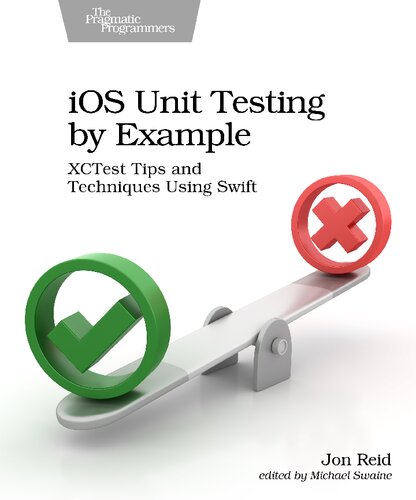
iOS Unit Testing by Example XCTest Tips and Techniques Using Swift 1st Edition by Jon Reid ISBN 1680506811 978-1680506815
Original price was: $50.00.$25.00Current price is: $25.00.
iOS Unit Testing by Example XCTest Tips and Techniques Using Swift 1st Edition by Jon Reid – Ebook PDF Instant Download/Delivery: 1680506811 , 978-1680506815
Full download iOS Unit Testing by Example XCTest Tips and Techniques Using Swift 1st edition after payment
Product details:
ISBN 10: 1680506811
ISBN 13: 978-1680506815
Author: Jon Reid
Fearlessly change the design of your iOS code with solid unit tests. Use Xcode’s built-in test framework XCTest and Swift to get rapid feedback on all your code – including legacy code. Learn the tricks and techniques of testing all iOS code, especially view controllers (UIViewControllers), which are critical to iOS apps. Learn to isolate and replace dependencies in legacy code written without tests. Practice safe refactoring that makes these tests possible, and watch all your changes get verified quickly and automatically. Make even the boldest code changes with complete confidence.
Manual code and UI testing get slower the deeper your navigation hierarchy goes. It can take several taps just to reach a particular screen, never mind the actual workflow tests. Automatic unit testing offers such rapid feedback that it can change the rules of development. Bring testing to iOS development, even for legacy code. Use XCTest to write unit tests in Swift for all your code.
iOS developers typically reserve unit tests for their model classes alone. But that approach skips most of the code common to iOS apps, especially with UIViewControllers. Learn how to unit test these view controllers to expand your unit testing possibilities. Since good unit tests form the bedrock for safe refactoring, you’re empowered to make bold changes. Learn how to avoid the most common mistakes Swift programmers make with the XCTest framework. Use code coverage to find holes in your test suites. Learn how to identify hard dependencies.
Reshape the design of your code quickly, with less risk and less fear.
iOS Unit Testing by Example XCTest Tips and Techniques Using Swift 1st Table of contents:
Part I. Foundations
1. Assert Yourself
What Are Unit Tests Anyway?
Create a Place to Play with Tests
Write Your First Assertion
Add a Descriptive Message
Avoid Conditionals in Tests
Describe Objects upon Failure
Test for Equality
Test Equality with Optionals
Fudge Equality with Doubles and Floats
Avoid Redundant Messages
Choose the Right Assertion
Key Takeaways
Activities
What’s Next?
2. Manage Your Test Life Cycles
Make a New Place to Play
Start from Test Zero
Hook Up Tests to Production Code
Examine Console Output
Observe Object Life Cycles to Learn the Phases of a Test
The Wrong Way to Reduce Duplicate Test Code
Learn How XCTest Manages Test Cases
Use setUp() and tearDown()
Key Takeaways
Activities
What’s Next?
3. Measure Code Coverage and Add Tests
Make a New Place to Play
Enable Code Coverage
Examine Code Coverage Results
Drill into a Partially Covered Line
Add Tests for Existing Code
Cover a Conditional
Cover a Loop
Cover Statements in a Sequence
Avoid Percentage Targets, Embrace Forward Movement
Key Takeaways
Activities
What’s Next?
4. Take Control of Application Launch
Make a New Place to Play
Observe the Default Behavior
Learn About the Test Launch Sequence
Bypass the Normal App Delegate
Put Up with the Initial View Controller
Tweak Your Testing App Delegate
Key Takeaways
Activities
What’s Next?
5. Load View Controllers
Make a New Place to Play
Set Up a Storyboard-Based View Controller for Experiments
Load a Storyboard-Based View Controller
Set Up a XIB-Based View Controller for Experiments
Load a XIB-Based View Controller
Set Up a Code-Based View Controller for Experiments
Load a Code-Based View Controller
Key Takeaways
Activities
What’s Next?
6. Manage Difficult Dependencies
Be Okay with Problem-Free Dependencies
Identify Difficult Dependencies
Create Boundaries to Isolate Dependencies
Make a New Place to Play
Add Backdoors to Singletons You Own
Subclass and Override: A Legacy Code Technique
Inject Instances Through Initializers or Properties
Inject Closures to Make New Instances
Key Takeaways
Activities
What’s Next?
Part II. iOS Testing Tips and Techniques
7. Testing Outlet Connections
Make a New Place to Play
Test Outlet Connections
Check the Effectiveness of Failure Messages
Key Takeaways
Activities
What’s Next?
8. Testing Button Taps (Using Actions)
Make a Place to Play with a Button
Test Button Taps
Make a Test Helper for Button Taps
Key Takeaways
Activities
What’s Next?
9. Testing Alerts
Make a New Place to Play
Add the Helper Framework to the Project
Test Alerts Using the Alert Verifier
Move the SUT into the Test Fixture
Add Tests for Alert Buttons
Key Takeaways
Activities
What’s Next?
10. Testing Navigation Between Screens
Make a New Place to Play
Set Up Code-Based Navigation
Set Up Segue-Based Navigation
Test Code-Based Push Navigation
Test Code-Based Modal Presentation
Test Segue-Based Push Navigation
Test Segue-Based Modal Navigation
Key Takeaways
Activities
What’s Next?
11. Testing UserDefaults (with Fakes)
Make a New Place to Play
Isolate UserDefaults with Dependency Injection
Extract a Protocol to Support Test Doubles
Make a Fake Object
Test UserDefaults
Key Takeaways
Activities
What’s Next?
12. Testing Network Requests (with Mocks)
Make a New Place to Play
Isolate URLSession with Dependency Injection
Extract a URLSession Protocol for Test Doubles
Make a Test Spy
Design the Test Case
Promote the Test Spy into a Mock Object
Improve Mock Object Reporting
Key Takeaways
Activities
What’s Next?
13. Testing Network Responses (and Closures)
Make a New Place to Play
Parse the Response
Start with a Fresh Test Spy
Design the Test Case
Test Asynchronous Code
Keep Asynchronous Code in Its Closure
Test an Error Scenario
Key Takeaways
Activities
What’s Next?
14. Testing Text Fields (and Delegate Methods)
Make a Place to Play
Test the Outlets
Test Attributes and Wrangle UIKit Descriptions
Test Delegate Methods
Test Input Focus
Key Takeaways
Activities
What’s Next?
15. Testing Table Views
Make a Place to Play
Test Table Views
Key Takeaways
Activities
What’s Next?
16. Testing View Appearance (with Snapshots)
Make a Place to Play
Add FBSnapshotTestCase to a Test Target
Set the Location for Reference Images
Write a Snapshot Test
See the Difference in a Snapshot Failure
Manage Your Snapshot Tests
Key Takeaways
Activities
What’s Next?
Part III. Using Your New Power
17. Unleash the Power of Refactoring
What Is Refactoring?
Lay Out the Views for Our Practice App
Add the Code to Our Practice App
Replace the Difficult Dependency with a Mock Object
Write the First Tests of the Change Password View Controller
Test the Cancel Button
Test the Submit Button
Test the Text Field Delegate Method
Refactor to Break Up a Long Function
Extract a Method with Parameters
Clean Up a Few More Places
Key Takeaways
What’s Next?
18. Refactoring: Moving to MVVM
What Is MVVM?
Replace String Literals to Use a View Model
Overwrite Storyboard Labels
Respond to Changes in the View Model
Move Logic into the View Model
Key Takeaways
What’s Next?
19. Refactoring: Moving to MVP
What Is MVP?
Set Up the MVP Types
Extract Methods into the View Commands Protocol
Move a Function into the Presenter
Remove the didSet Observer
Use Refactoring Principles to Reparent a Swift Type
Move Several Functions to the Presenter
Extract Password Validation into Its Own Type
Finish Up the Refactoring to MVP
Key Takeaways
What’s Next?
20. Test-Driven Development Beckons to You
What Is TDD?
Make a New Place to Play with TDD
Define the Requirements of the Time-of-Day Greeter
Design the First Failing Test with Bare Production Code
Make the First Test Pass with “Good Morning”
Refactor the First Test to Make It More Expressive
Repeat the TDD Steps for the Second Test
Add Tests to Expand “Good Afternoon”
Implement “Good Evening”
Step Back to Refactor the Method as a Whole
Add the Name to the Greeting
Key Takeaways
What’s Next?
Bibliography
People also search for iOS Unit Testing by Example XCTest Tips and Techniques Using Swift 1st:
ios unit test best practices
ios unit tests
ios testing xctest
ios unit testing tutorial
xcode ui testing best practices
Tags: Jon Reid, iOS Unit, Techniques Using
You may also like…
Computers - Programming
Writing Great Specifications: Using Specification by Example and Gherkin 1st Edition Kamil Nicieja
Computers - Programming
Agile Swift: Swift Programming Using Agile Tools and Techniques Godfrey Nolan
Computers - Programming
Computers - Programming
Computers - Programming