

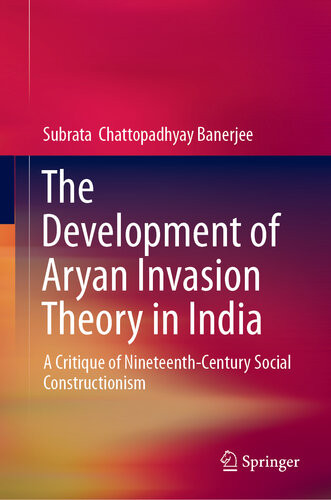
The Development of Aryan Invasion Theory in India A Critique of Nineteenth Century Social Constructionism 1st Edition by Subrata Chattopadhyay Banerjee ISBN 978-9811377556 9811377556


Original price was: $50.00.$25.00Current price is: $25.00.
The Development of Aryan Invasion Theory in India A Critique of Nineteenth Century Social Constructionism 1st Edition by Subrata Chattopadhyay Banerjee – Ebook PDF Instant Download/Delivery: 978-9811377556, 9811377556
Full download The Development of Aryan Invasion Theory in India A Critique of Nineteenth Century Social Constructionism 1st Edition after payment
Product details:
ISBN 10: 9811377556
ISBN 13: 978-9811377556
Author: Subrata Chattopadhyay Banerjee
This book delves deep into the Social Construction of Theory, comparative epistemology and intellectual history to stress the interrelationship between diverse cultures during the colonial period and bring forth convincing evidence of how the 19th century was shaped. It approaches an interesting relation between the linguistic studies of 19th century’s scientific world and subsequent widespread acceptance of the empirically weak theory of the Aryan invasion. To show entangled history in a globalized world, the book draws on the Aryan Invasion Theory to highlight how different socio-religious parties commonly shape a new theory. It also explores how research is affected by the so-called social construction of theory and comparative epistemology, and deals with scholarly advancement and its relation with contemporary socio-political demands. The most significant conclusion of the book is that academic studies are prone to comparative epistemology, even under the strict scrutiny of theso-called scientific methods.
Table of contents:
Chapter 1. Introduction
Chapter 2. Max Müller’s Beginning of Modern Religious Study and the Silent Formulation of the Aryan Invasion Theory
2.1. Introduction
2.2. From Curiosity to a Common Past: The Study of Ancient Indian Literature in Europe
2.3. The Emergence of Max Müller in the European Scientific Scene
2.4. Max Müller’s First Synthesis: Science of Language
2.5. Max Müller’s Second Synthesis: Science of Religion
2.6. Max Müller’s Silent Formulation of the Aryan Invasion Theory
2.7. Conclusion
Chapter 3. Brahmo Samaj as an Actor in the Dissemination of the Aryan Invasion Theory in India
3.1. Introduction
3.2. A Short Overview of the Brahmo Samaj
3.3. The Coagulation of the Brahmo Samaj: From Conflict to Collaboration with Christian Missionaries
3.4. Keshub’s New Synthesis: Making the Brahmo Samaj Truly Universal
3.5. The Aryan Invasion Theory and Its Contradiction with Christianity
3.6. Using the Tools of the British Empire: The Politicization of the Brahmo Samaj
3.7. Summary
Chapter 4. The Role of Christian Missionaries in the Formulation and Spread of the Aryan Invasion Theory in India
4.1. Christianity in Nineteenth-Century Europe
4.2. The Oxford Movement
4.3. Colonial Missions
4.4. History of Christian Missions in India
4.5. Missionary Interest in India: Methods and Outcomes
4.6. Initial Setbacks of Missions: Insurmountable Obstacles
4.7. Interaction with Indian Social Reformers
4.8. Intellectual Conflict between Missionaries and Social Reformers
4.9. The Educational Reform Movement: A New Strategy
4.10. Christianity and Colonialism in India
4.11. The Discovery of the Aryan Invasion Theory
4.12. Müller’s Role in Linguistic Studies: Colonial Ties
4.13. Reactions of Christian Missionary Groups to the Aryan Myth
4.14. The Aryan Invasion Theory and the Role of Christian Missions in India
4.15. The Vedantist Movement in Calcutta after Rammohun
4.16. Reactions of Social Reformers: Dayanand Saraswati, Bal Gangadhar Tilak, Jyotirao Phule
4.17. Divide and Rule
4.18. Adoption by Christian Missionaries: A New Method
4.19. Müller’s Communications with Social Reformers in India and the Propagation of the Aryan Invasion Theory
4.20. Conclusion
Chapter 5. Summary
5.1. Extending the Research on Max Müller
5.2. Future Directions
People also search for:
describe the aryans
why did the aryans go to india
why did the aryans invade the indus valley
how did the aryans defeat the original inhabitants of india
how did the aryans contribute to hinduism
Tags: Subrata Chattopadhyay Banerjee, The Develop, ment, Aryan Invasion, A Critique of Nineteenth
You may also like…

Business & Economics - Economics
A History of Economic Thought in France : The Long Nineteenth Century 1st Edition Gilbert Faccarello

Arts - History & Criticism

Poetry - American Poetry
Fictions of the Press in Nineteenth-Century France Edmund Birch
Politics & Philosophy
Marx’s Associated Mode of Production: A Critique of Marxism 1st Edition Paresh Chattopadhyay

History
The Brink Of Freedom Improvising Life In The Nineteenth Century Atlantic World David Kazanjian
Biology and other natural sciences - Paleontology
Politics & Philosophy - Anthropology