
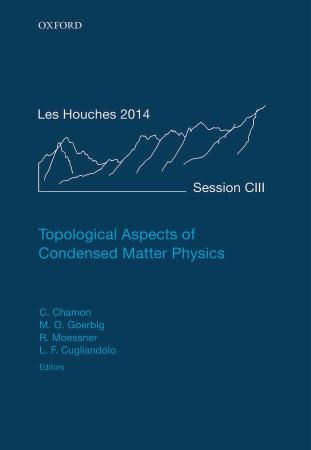
Topological Aspects of Condensed Matter Physics Lecture Notes of the Les Houches Summer School Volume 103 August 2014 1st Edition by Claudio Chamon, Mark Goerbig, Roderich Moessner, Leticia Cugliandolo ISBN B06WGRK34V 978-0191088797

Original price was: $50.00.$25.00Current price is: $25.00.
Topological Aspects of Condensed Matter Physics: Lecture Notes of the Les Houches Summer School: Volume 103, August 2014 1st Edition by Claudio Chamon, Mark Goerbig, Roderich Moessner, Leticia Cugliandolo – Ebook PDF Instant Download/Delivery: B06WGRK34V, 978-0191088797
Full download Topological Aspects of Condensed Matter Physics: Lecture Notes of the Les Houches Summer School: Volume 103, August 2014 1st edition after payment
Product details:
ISBN 10: B06WGRK34V
ISBN 13: 978-0191088797
Author: Claudio Chamon, Mark Goerbig, Roderich Moessner, Leticia Cugliandolo
This book contains lecture notes by world experts on one of the most rapidly growing fields of research in physics. Topological quantum phenomena are being uncovered at unprecedented rates in novel material systems. The consequences are far reaching, from the possibility of carrying currents and performing computations without dissipation of energy, to the possibility of realizing platforms for topological quantum computation.The pedagogical lectures contained in this book are an excellent introduction to this blooming field. The lecture notes are intended for graduate students or advanced undergraduate students in physics and mathematics who want to immerse in this exciting XXI century physics topic.
This Les Houches Summer School presents an overview of this field, along with a sense of its origins and its placement on the map of fundamental physics advancements. The School comprised a set of basic lectures (part 1) aimed at a pedagogical introduction of the fundamental concepts, which was accompanied by more advanced lectures (part 2) covering individual topics at the forefront of today’s research in condensed-matter physics.
Topological Aspects of Condensed Matter Physics: Lecture Notes of the Les Houches Summer School: Volume 103, August 2014 1stTable of contents:
Part I Basic Lectures
1 An introduction to topological phases of electrons
Joel E. Moore
1.1 Introduction
1.2 Basic concepts
1.2.1 Mathematical preliminaries
1.2.2 Berry phases in quantum mechanics
1.3 Topological phases: Thouless phases arising from Berry phases
1.3.1 Bloch states
1.3.2 1D polarization and 2D IQHE
1.3.3 Interactions and disorder: the flux trick
1.3.4 TKNN integers, Chern numbers, and homotopy
1.3.5 Time-reversal invariance in Fermi systems
1.3.6 Experimental status of 2D insulating systems
1.3.7 3D band structure invariants and topological insulators
1.3.8 Axion electrodynamics, second Chern number, and magnetoelectric polarizability
1.3.9 Anomalous Hall effect and Karplus–Luttinger anomalous velocity
1.4 Introduction to topological order
1.4.1 FQHE background
1.4.2 Topological terms in field theories: the Haldane gap and Wess–Zumino–Witten models
1.4.3 Topologically ordered phases: the FQHE
1.A Topological invariants in 2D with time-reversal invariance
1.A.1 An interlude: Wess–Zumino terms in 1D nonlinear σ-models
1.A.2 Topological invariants in time-reversal-invariant Fermi systems
1.A.3 Pumping interpretation of Z2 invariant
References
2 Topological superconductors and category theory
Andrei Bernevig and Titus Neupert
Preface
2.1 Introduction to topological phases in condensed matter
2.1.1 The notion of topology
2.1.2 Classification of non-interacting fermion Hamiltonians: the 10-fold way
2.1.3 The Su–Schrieffer–Heeger model
2.1.4 The 1D p-wave superconductor
2.1.5 Reduction of the 10-fold way classification by interactions:
2.2 Examples of topological order
2.2.1 The toric code
2.2.2 The 2D p-wave superconductor
2.3 Category theory
2.3.1 Fusion category
2.3.2 Braiding category
2.3.3 Modular matrices
2.3.4 Examples: the 16-fold way revisited
Acknowledgements
References
3 Spin liquids and frustrated magnetism
John T. Chalker
3.1 Introduction
3.1.1 Overview
3.1.2 Classical ground-state degeneracy
3.1.3 Order by disorder
3.2 Classical spin liquids
3.2.1 Simple approximations
3.2.2 The triangular lattice Ising antiferromagnet and height models
3.3 Classical dimer models
3.3.1 Introduction
3.3.2 General formulation
3.3.3 Flux sectors, and U(1) and Z2 theories
3.3.4 Excitations
3.4 Spin ices
3.4.1 Materials
3.4.2 Coulomb phase correlations
3.4.3 Monopoles
3.4.4 Dipolar interactions
3.5 Quantum spin liquids
3.5.1 Introduction
3.5.2 Lieb–Schultz–Mattis theorem
3.5.3 Quantum dimer models
3.6 Concluding remarks
3.6.1 Slave particles
3.6.2 Numerics
3.6.3 Summary
Acknowledgements
References
4 Entanglement spectroscopy and its application to the quantum Hall effects
Nicolas Regnault
Preface
4.1 Introduction
4.2 Entanglement spectrum and entanglement entropy
4.2.1 Definitions
4.2.2 A simple example: two spin- 1/2
4.2.3 Entanglement entropy
4.2.4 The AKLT spin chain
4.2.5 Matrix product states and the entanglement spectrum
4.3 Observing an edge mode through the entanglement spectrum
4.3.1 The integer quantum Hall effect
4.3.2 Chern insulators
4.3.3 Entanglement spectrum for a CI
4.4 Fractional quantum Hall effect and entanglement spectra
4.4.1 Fractional quantum Hall effect: overview and notation
4.4.2 Orbital entanglement spectrum
4.4.3 OES beyond model wavefunctions
4.4.4 Particle entanglement spectrum
4.4.5 Real-space entanglement spectrum
4.5 Entanglement spectrum as a tool: probing the fractional Chern insulators
4.5.1 From Chern insulators to fractional Chern insulators
4.5.2 Entanglement spectrum for fractional Chern insulators
4.6 Conclusions
Acknowledgements
References
Part II Topical lectures
5 Duality in generalized Ising models
Franz J. Wegner
Preface
5.1 Introduction
5.2 Kramers–Wannier duality
5.2.1 High-temperature expansion (HTE)
5.2.2 Low-temperature expansion (LTE)
5.2.3 Comparison
5.3 Duality in three dimensions
5.4 General Ising models and duality
5.4.1 General Ising models
5.4.2 Duality
5.5 Lattices and Ising models
5.5.1 Lattices and their dual lattices
5.5.2 Models on the lattice
5.5.3 Euler characteristic and degeneracy
5.6 The models Md,n on hypercubic lattices
5.6.1 Gauge invariance and degeneracy
5.6.2 Self-duality
5.7 Correlations
5.7.1 The model Mdd
5.7.2 Dislocations
5.8 Lattice gauge theories
5.9 Electromagnetic field
References
6 Topological insulators and related phases with strong interactions
Ashvin Vishwanath
6.1 Overview
6.2 Quantum phases of matter. Short-range versus long-range entanglement
6.3 Examples of SRE topological phases
6.3.1 Haldane phase of S = 1 antiferromagnet in d = 1
6.3.2 An exactly soluble topological phase in d = 1
6.4 SRE phase of bosons in two dimensions
6.4.1 Coupled-wire construction
6.4.2 Effective field theory
6.4.3 Implications for IQH state of electrons
6.5 SPT phases of bosons in three dimensions
6.5.1 The m = 0 critical point
6.5.2 Surface topological order of 3D bosonic SRE phases
6.6 Surface topological order of fermionic topological insulators and superconductors
Acknowledgements
References
7 Fractional Abelian topological phases of matter for fermions in two-dimensional space
Christopher MUDRY
7.1 Introduction
7.2 The tenfold way in quasi-one-dimensional space
7.2.1 Symmetries for the case of one one-dimensional channel
7.2.2 Symmetries for the case of two one-dimensional channels
7.2.3 Definition of the minimum rank
7.2.4 Topological spaces for the normalized Dirac masses
7.3 Fractionalization from Abelian bosonization
7.3.1 Introduction
7.3.2 Definition
7.3.3 Chiral equations of motion
7.3.4 Gauge invariance
7.3.5 Conserved topological charges
7.3.6 Quasiparticle and particle excitations
7.3.7 Bosonization rules
7.3.8 From the Hamiltonian to the Lagrangian formalism
7.3.9 Applications to polyacetylene
7.4 Stability analysis for the edge theory in symmetry class AII
7.4.1 Introduction
7.4.2 Definitions
7.4.3 Time-reversal symmetry of the edge theory
7.4.4 Pinning the edge fields with disorder potentials: the Haldane criterion
7.4.5 Stability criterion for edge modes
7.4.6 The stability criterion for edge modes in the FQSHE
7.5 Construction of two-dimensional topological phases from coupled wires
7.5.1 Introduction
7.5.2 Definitions
7.5.3 Strategy for constructing topological phases
7.5.4 Reproducing the tenfold way
7.5.5 Fractionalized phases
7.5.6 Summary
Acknowledgements
References
8 Symmetry-protected topological phases in one-dimensional systems
Frank Pollmann
8.1 Introduction
8.2 Entanglement and matrix product states
8.2.1 Schmidt decomposition and entanglement
8.2.2 Area law
8.2.3 Matrix product states
8.3 Symmetry-protected topological phases
8.3.1 Symmetry transformations of MPS
8.3.2 Classification of projective representations
8.3.3 Symmetry fractionalization
8.3.4 Spin-1 chain and the Haldane phase
8.4 Detection
8.4.1 Degeneracies in the entanglement spectrum
8.4.2 Extraction of projective representations from the mixed transfermatrix
8.4.3 String order parameters
8.5 Summary
Acknowledgement
References
9 Topological superconducting phasesin one dimension
Felix von Oppen, Yang Peng,and Falko Pientka
9.1 Introduction
9.1.1 Motivation
9.1.2 Heuristic arguments
9.2 Spinless p-wave superconductors
9.2.1 Continuum model and phase diagram
9.2.2 Domain walls and Majorana excitations
9.2.3 Topological protection and many-body ground states
9.2.4 Experimentally accessible systems
9.3 Topological insulator edges
9.3.1 Model and phases
9.3.2 Zero-energy states and Majorana operators
9.4 Quantum wires
9.4.1 Kitaev limit
9.4.2 Topological insulator limit
9.5 Chains of magnetic adatoms on superconductors
9.5.1 Shiba states
9.5.2 Adatom chains
9.5.3 Kitaev chain
9.6 Non-Abelian statistics
9.6.1 Manipulation of Majorana bound states
9.6.2 Non-Abelian Berry phase
9.6.3 Braiding Majorana zero modes
9.7 Experimental signatures
9.7.1 Conductance signatures
9.7.2 4π-periodic Josephson effect
9.8 Conclusions
9.A Pairing Hamiltonians: BdG and second quantization
9.B Proximity-induced pairing
9.C Shiba states
9.C.1 Adatom as a classical magnetic impurity
9.C.2 Adatom as a spin-12 Anderson impurity
Acknowledgements
References
10 Transport of Dirac surface states
D. Carpentier
10.1 Introduction
10.1.1 Purpose of the lectures
10.1.2 Dirac surface states of topological insulators
10.1.3 Graphene
10.1.4 Overview of transport properties
10.2 Minimal conductivity close to the Dirac point
10.2.1 Zitterbewegung
10.2.2 Clean large tunnel junction
10.2.3 Minimal conductivity from linear response theory
10.3 Classical conductivity at high Fermi energy
10.3.1 Boltzmann equation
10.3.2 Linear response approach
10.4 Quantum transport of Dirac fermions
10.4.1 Quantum correction to the conductivity: weak antilocalization
10.4.2 Universal conductance fluctuations
10.4.3 Notion of universality class
10.4.4 Effect of a magnetic field
Acknowledgements
References
11 Spin textures in quantum Hall systems
Benoît Douçot
11.1 Introduction
11.2 Physical properties of spin textures
11.2.1 Intuitive picture
11.2.2 Construction of spin textures
11.2.3 Energetics of spin textures
11.2.4 Choice of an effective model
11.2.5 Classical ground states of the CPd−1 model
11.3 Periodic textures
11.3.1 Perturbation theory for degenerate Hamiltonians
11.3.2 Remarks on the Hessian of the exchange energy
11.3.3 Variational procedure for energy minimization
11.3.4 Properties of periodic textures
11.4 Collective excitations around periodic textures
11.4.1 Time-dependent Hartree–Fock equations
11.4.2 Collective-mode spectrum
11.4.3 Towards an effective sigma model description
11.A Coherent states in the lowest Landau level
11.B From covariant symbols on a two-dimensional plane to operators
11.C Single-particle density matrix in a texture Slater determinant
11.D Hamiltonians with quadratic covariant symbol
Acknowledgements
References
12 Out-of-equilibrium behaviour in topologically ordered systems on a lattice: fractionalized excita
Claudio Castelnovo
Preface
12.1 Topological order, broadly interpreted
12.2 Example 1: (classical) spin ice
12.2.1 Thermal quenches
12.2.2 Field quenches
12.3 Example 2: Kitaev’s toric code
12.3.1 The model
12.3.2 Elementary excitations
12.3.3 Dynamics
12.3.4 Intriguing comparison: kinetically constrained models
12.4 Conclusions
Acknowledgements
References
13 What is life?—70 years after Schrödinger
Antti J. Niemi
Preface
13.1 A protein minimum
13.1.1 Why proteins?
13.1.2 Protein chemistry and the genetic code
13.1.3 Data banks and experiments
13.1.4 Phases of proteins
13.1.5 Backbone geometry
13.1.6 Ramachandran angles
13.1.7 Homology modelling
13.1.8 All-atom models
13.1.9 All-atom simulations
13.1.10 Thermostats
13.1.11 Other physics-based approaches
13.2 Bol’she
13.2.1 The importance of symmetry breaking
13.2.2 An optical illusion
13.2.3 Fractional charge
13.2.4 Spin–charge separation
13.2.5 All-atom is Landau liquid
13.3 Strings in three space dimensions
13.3.1 Abelian Higgs model and the limit of slow spatial variations
13.3.2 The Frenet equation
13.3.3 Frame rotation and Abelian Higgs multiplet
13.3.4 The unique string Hamiltonian
13.3.5 Integrable hierarchy
13.3.6 Strings from solitons
13.3.7 Anomaly in the Frenet frames
13.3.8 Perestroika
13.4 Discrete Frenet frames
13.4.1 The Cα trace reconstruction
13.4.2 Universal discretized energy
13.4.3 Discretized solitons
13.4.4 Proteins out of thermal equilibrium
13.4.5 Temperature renormalization
13.5 Solitons and ordered proteins
13.5.1 λ-repressor as a multisoliton
13.5.2 Structure of myoglobin
13.5.3 Dynamical myoglobin
13.6 Intrinsically disordered proteins
13.6.1 Order versus disorder
13.6.2 hIAPP and type 2 diabetes
13.6.3 hIAPP as a three-soliton
13.6.4 Heating and cooling hIAPP
13.7 Beyond Cα
13.7.1 ‘What-you-see-is-what-you-have’
People also search for Topological Aspects of Condensed Matter Physics: Lecture Notes of the Les Houches Summer School: Volume 103, August 2014 1st:
history of condensed matter physics
why is condensed matter physics important
principles of condensed matter physics
topological phases in condensed matter physics
topology and condensed matter
Tags: Claudio Chamon, Mark Goerbig, Roderich Moessner, Leticia Cugliandolo, Topological Aspects, Condensed Matter
You may also like…

Uncategorized
Mathematics - Algebra


Science (General)